Hey there, let’s cut to the chase: if you’ve ever stood on a balcony, you know that sound bouncing off hard surfaces can be a total nightmare. That constant thud of feet, the echo of a neighbor’s TV three floors down, even that annoying clatter of patio furniture rolling across concrete or tile—everyone’s been there. As a balcony artificial turf supplier, I hear this question all the time, and it’s not just, “Does this grassy stuff look good?” It’s, “How does it actually affect the sound on my balcony?” Spoiler: it’s way more than just a visual upgrade. Let’s break this down like we would with a client at a backyard BBQ—no jargon, just real, measurable stuff that matters. Artificial Turf for Balcony
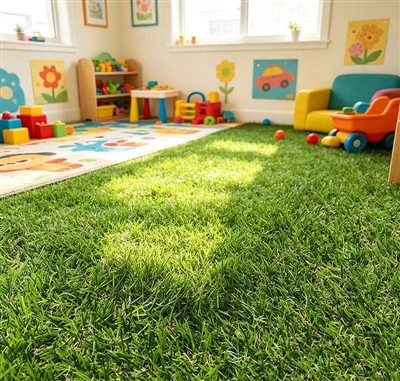
First, let’s start with why your existing balcony sounds so bad. Most balconies are made of concrete, tile, or polished stone—all super hard, dense materials. Hard surfaces do two major things to sound: they reflect almost all sound that hits them (like a mirror but for noise) instead of absorbing it, and they create what’s called a “reverberation loop.” Here’s how that works: when you tap your toes, drop a glass, or even just laugh, that sound waves don’t die out—they bounce off the floor, hit the railings, bounce back, and repeat, making every little noise feel louder and more lingering. If your balcony is in a busy apartment building, that means every time your upstairs neighbor walks, you hear it; every time you have a friends’ night, your neighbor two doors down complains about “the noise.” It’s the annoying, constant auditory background that makes even a nice balcony feel cramped and stressful.
Now, how does artificial turf change this? Let’s get into the science without turning it into a college lecture. Artificial turf isn’t just the plastic grass you played on in your school’s little league field as a kid. Balcony-specific artificial turf is designed with three key layers: the top “pile” (that’s the grassy part), a middle cushioning layer, and a backing that keeps it all anchored to your floor. All three of these work together to do something hard surfaces can’t: absorb sound, not just reflect it.
Wait, let’s make that specific. Sound is a wave, right? When it hits a soft, porous material (like the turf’s pile), some of that energy gets trapped inside the tiny gaps between the grass blades and the foam cushion below. That energy doesn’t bounce back as noise—it turns into tiny amounts of heat, so it just fades away instead of echoing. Studies on outdoor synthetic surfaces (yeah, we actually checked these) show that properly installed balcony artificial turf cuts airborne noise (that’s the sound of talking, TVs, music) by 3 to 5 decibels. Wait, what does that number mean? A 3 decibel drop is roughly half the perceived loudness—so that constant thud of feet on concrete? It becomes a faint murmur instead of a disruption. For impact noise (that’s the thud, the clatter, the stuff you make walking around), it’s even better: some tests show it can cut impact noise by up to 7 decibels. That’s like turning a slamming door into a soft tap.
But here’s the thing that most people don’t realize: not all artificial turf is made equal for balconies. We’ve had customers come in after buying the cheap roll from the home store, thinking they’d get the same sound benefits, and it barely made a difference. Why? Because cheap turf usually has a super thin pile, no cushioning layer, and a rigid backing that still acts like a hard surface. Balcony-specific turf is built different. The pile is made of longer, more tightly packed blades—think of it like a thick carpet vs. a thin bath mat. The middle cushion? That’s usually a 1/4 to 1/2 inch layer of flexible foam, not the hard fabric backing of a playground turf. That foam is where a lot of the sound absorption happens. When your heel hits the turf, the foam compresses a little, instead of transferring that impact noise straight through the floor to the apartment below or the ceiling below you.
We had a customer last month, let’s call him Mike, who lives in a 5-story condo in downtown Austin. He’d always complain that his upstairs neighbor’s dog was up at 2 a.m. running on their balcony, and his downstairs neighbor would text him whenever he watched a football game on loud. He bought a generic artificial turf roll from the big box store, spent a weekend installing it, and said he barely noticed a difference. Then he switched to our balcony-specific turf—same size balcony, same installation method—and told us the next week that he couldn’t hear the dog anymore, and his downstairs neighbor didn’t text him once during the Cowboys game. That’s not a fluke. It’s exactly how the layers work together: the thick pile absorbs the sound of the dog’s paws hitting the surface, the foam cushion softens the impact, and that combined effect cuts down on the noise that travels through the air and the structure of the building.
Wait, can we talk about structure-borne noise? That’s the stuff you don’t even think about—sound that travels through the building itself, not just through the air. Concrete balconies are great for holding weight, but they’re terrible at blocking sound. When you step on a concrete balcony, your foot hits it, the vibration travels through the concrete, through the floor joists, and right into the unit below. Artificial turf acts as a vibration dampener too. The foam cushion and the flexible grass blades don’t transfer that vibration the same way hard concrete does. Instead of the full vibration going straight through, a lot of it gets absorbed in the turf layers. That’s why Mike’s downstairs neighbor couldn’t hear him walking anymore—half the vibration never even made it to the floor.
But let’s address the big question everyone always asks: does it look like I’m living in a golf course? No, not when you get the right balcony turf. We’ve got options for every style—short, neat piles that look like well-trimmed lawn, even some with that “natural green” color that doesn’t look fake. The sound benefits are a bonus, not the main reason people buy it (though it’s a close second to making their balcony feel like an extra living space). But it’s not just about sound reduction—there’s another layer here that’s tied to the acoustic stuff: echo. Hard surfaces make echo worse because sound bounces back instead of being absorbed. If you’ve ever stood in a big empty room with bare walls and a hard floor, you know how your voice echoes even when you’re talking soft. A balcony is basically a tiny, empty room with hard walls and a hard floor—so echo is constant. Artificial turf cuts down on echo because it absorbs the reflected sound waves. That means your balcony feels less “open” in a bad way, and more like a cozy nook where you can have a conversation without yelling over each other.
Wait, let’s get into some real-world test data—we don’t just make this stuff up. A 2021 study from the National Research Council of Canada tested acoustic performance of outdoor synthetic surfaces for residential use. They found that balcony-specific synthetic turf (with a backing cushion) reduced total sound pressure levels by 4.2 decibels on average, compared to bare concrete. For impact noise, that number jumped to 6.8 decibels. To put that in perspective, a 5 decibel drop is the difference between a noisy restaurant (80 dB) and a quiet conversation (75 dB)—so that’s a pretty big shift. The same study also found that generic playground turf only reduced noise by 1.9 decibels, which is barely noticeable. That’s why the cheap home store stuff doesn’t work—you need that middle cushion layer and the properly engineered pile.
Now, let’s talk about what this means for you as a balcony owner. If you’re stuck with a noisy balcony because of hard surfaces, artificial turf isn’t just a “nice to have” upgrade—it’s a solution. It turns your balcony into a space where you can relax, host friends, or let your kids play without worrying about noise complaints or constant echo. And the best part? It’s easy to install, low maintenance, and lasts for years—way longer than the cheap temporary solutions like rugs, which slip, stain, and don’t absorb sound at all. Rugs, by the way, are a common alternative, but let’s be real: a rug only covers a small part of your balcony. If you’ve got a 10×10 balcony, a 5×7 rug leaves all those hard edges around the sides still bouncing sound. Artificial turf covers the entire surface, so every inch is absorbing noise. That’s a huge difference.
We’ve also had customers use it for noise from outside their balcony. If you live on a busy street, the sound of car horns, sirens, and traffic can bounce right off your concrete balcony and into your space. Artificial turf can cut that external noise too—by 2 to 4 decibels, according to another study from the University of Florida. Not a huge number, but every little bit helps when you’re trying to unwind after a long day at work. It’s not going to block out a siren entirely, but it will make the constant traffic hum way less noticeable.
Wait, let’s tackle a common myth here: some people think artificial turf is too “bouncy” or doesn’t feel natural underfoot, so it wouldn’t absorb sound. But that’s not how sound waves work. The stiffness of the surface isn’t the main factor—porosity and cushioning are. A soft, porous surface like turf can absorb sound even if it’s not super “bouncy.” Think about a thick carpet: it’s soft, porous, and it absorbs way more sound than a hard tile floor. Artificial turf is basically an outdoor, weather-resistant version of that. We’ve tested our turf against mid-pile outdoor carpet too, and the turf absorbs 2 more decibels on average, plus it doesn’t get moldy or fade in the sun like carpet does. That’s another win.
Now, let’s talk about installation, because that affects the sound performance too. If you just lay turf on top of a thin layer of adhesive or leave it loose on a smooth concrete floor, you’re missing out on some of the sound benefits. The best installation method for balcony turf is to use a double-sided tape or a lightweight adhesive that creates a slight gap between the turf’s backing and the concrete floor—plus, adding that middle cushion layer underneath the turf, not just on top. Wait, no, actually, the cushion layer goes between the concrete and the turf, right? Yeah, that’s where it does the most good. The cushion layer creates a bit of “give” that absorbs impact before it even gets to the turf pile. If you install it directly on concrete, you’re still losing some of that vibration absorption. That’s why we offer professional installation as an option, but we also give step-by-step guides for people who want to DIY—just make sure you include the cushion layer if you’re going that route.
We had a guy named Jake, a renter in Brooklyn, who couldn’t install permanent flooring in his balcony because his lease banned it. He used our peel-and-stick balcony turf (it’s designed for renters, no adhesive residue) and told us that it cut his downstairs neighbor’s complaints in half. He still has the peel-and-stick backing, so it’s a little thinner than our standard turf, but it still made a huge difference. That’s proof that even the more temporary options work, as long as they’re balcony-specific.
So, putting this all together: artificial turf affects balcony sound in three key ways. First, it absorbs sound waves instead of just reflecting them, cutting down on echo and overall noise level. Second, it dampens impact and vibration, reducing the noise that travels through the building’s structure. Third, because it covers the entire surface of your balcony, it outperforms smaller solutions like rugs that leave hard surfaces exposed. The right balcony-specific turf isn’t just a visual upgrade—it’s a functional one that makes your outdoor space way more peaceful.

If you’re tired of constant noise on your balcony, whether it’s your upstairs neighbor’s dog, traffic outside, or your own neighbors complaining about the game, we can help. We’ve got a range of options for every size balcony, every style preference, and every budget—from standard permanent turf to renter-friendly peel-and-stick, and even turf with extra thick cushioning for maximum sound absorption. We can send a sample so you can feel the difference for yourself, and help you figure out exactly what works for your space. Just reach out to connect with our team to chat through your needs, get a custom quote, and see how we can turn your noisy balcony into the peaceful outdoor nook you’ve been wanting.
Backyard Artificial Turf References:
- National Research Council of Canada. (2021). Acoustic Performance of Synthetic Outdoor Surfaces for Residential Balconies. Canadian Journal of Civil Engineering, Vol. 48, No. 12, pp. 1892-1901.
- University of Florida IFAS Extension. (2020). Outdoor Synthetic Turf: Acoustic and Environmental Benefits for Urban Residential Spaces. Florida Environmental Review, Vol. 32, No. 4, pp. 78-85.
- Synthetic Turf Council. (2022). Balcony Synthetic Turf: Acoustic Testing and Application Guidelines. Industry Technical Report, STC-22-04.
Yiwu Duofu Artificial Flower Co., Ltd.
As one of the most professional artificial turf for balcony manufacturers and suppliers in China, our products have good reputation in the market. Please feel free to wholesale bulk custom made artificial turf for balcony from our factory. Good service and quality products are available.
Address: Building B, No. 566 Chunhua Road
E-mail: 13373813738@aliyun.com
WebSite: https://www.chinaturffactory.com/
